
Patients typically resume normal activities right after their scan, since no contrast agents or radiation are involved.
Whole-Body MRI in Denver
A proactive, radiation-free full body scan in Denver — see what’s happening before symptoms ever appear.
At a Glance
Our whole-body MRI scan evaluates your body for early signs of cancer, aneurysms, and other structural abnormalities — without radiation or contrast agents. It’s designed to give you a comprehensive, whole-body view of your health in a single, non-invasive appointment, and most patients resume normal activities immediately afterward, with no recovery time needed.
What Is Whole-Body MRI?
Magnetic Resonance Imaging (MRI) uses powerful magnets and radio waves — not radiation — to generate detailed images of the body’s internal structures. A whole-body MRI expands this beyond a single targeted area, offering a broad, system-level look across multiple regions in one visit. Rather than investigating a specific symptom, it’s designed for early insight, even when nothing feels wrong.
Here, that means screening 33 organs in a single appointment under an hour, using high-resolution, multi-parametric imaging that captures more diagnostic detail than routine MRI — with every result reviewed by a team of board-certified radiologists and supported by AI-assisted analysis.
And because results build over time, not just once: repeat imaging lets your provider distinguish a genuinely new finding from one that’s been stable for years — a distinction with very different clinical significance. Paired with our diagnostic blood testing, whole-body MRI becomes part of an ongoing picture of your health, not an isolated data point.
The Scan, By the Numbers
1.3B
Data points in under one hour
33
Organs covered per scan
60M
Conditions assessed since 2018
What Body Regions Does a Whole-Body Scan Assess?
An MRI scan evaluates several key regions of the body, each providing detailed insight into specific tissues and structures. Below is a breakdown of what's assessed in each area.
| Region | What's Assessed |
|---|---|
| Brain & Neurological Structures | Brain tissue and structural abnormalities |
| Spine & Musculoskeletal System | Spinal structure, joints, and soft tissue |
| Abdominal Organs | Liver, kidneys, pancreas, and surrounding structures |
| Soft Tissue & Lymphatic Regions | Lymph nodes and soft tissue throughout the body |
- Radiation-free — no exposure to ionizing radiation
- Non-invasive — no needles, incisions, or preparation beyond removing metal objects
- Contrast-free — no injected contrast agents required
Whole-Body MRI vs. Other Imaging
Patients considering a full body scan in Denver often want to understand how MRI stacks up against other common imaging methods. Here's how they compare.
| Attribute | Whole-Body MRI | CT Scan | X-Ray | Ultrasound |
|---|---|---|---|---|
| Uses radiation | No | Yes | Yes | No |
| Coverage area | Whole-body in a single session | Targeted region per scan | Single targeted area | Single targeted area |
| Best suited for | Soft tissue detail, broad proactive screening | Bone detail, trauma, rapid diagnosis | Bone fractures, chest screening | Real-time, soft tissue, prenatal imaging |
| Typical use case | Proactive baseline screening without a specific symptom | Investigating a specific suspected issue | Investigating a specific suspected issue | Investigating a specific suspected issue |
| Contrast typically required | No (Prenuvo protocol) | Often | No | No |
| Typical scan time | Under an hour | Minutes | Minutes | Minutes to ~30 min |
What a Full-Body MRI May Help Detect
A full-body MRI is a screening tool, not a diagnostic test on its own — but it can flag findings worth further evaluation across a wide range of areas, including:
- Early-stage tumors and masses
- Aneurysms
- Cysts and benign growths
- Fatty liver disease
- Enlarged organs
- Lung nodules
- Herniated or degenerated discs
- Joint degeneration
- Thyroid nodules
- Kidney abnormalities
- Vascular abnormalities
- Structural brain changes
A full-body MRI is a screening tool and does not diagnose any specific condition on its own. Any findings will be reviewed with you by your provider, who will determine appropriate next steps or referrals.
What to Expect
Your Whole-Body MRI is a straightforward, physician-guided process from start to finish.
1
Consultation
A brief review of your health history and goals for the scan, so our team understands what matters most to you before you begin.
2
Preparation
Avoid eating for 4 hours before your appointment, and drink only clear liquids during that time. You'll also remove metal objects, jewelry, and electronic devices, and change into comfortable scan attire provided at our office.
3
The Scan
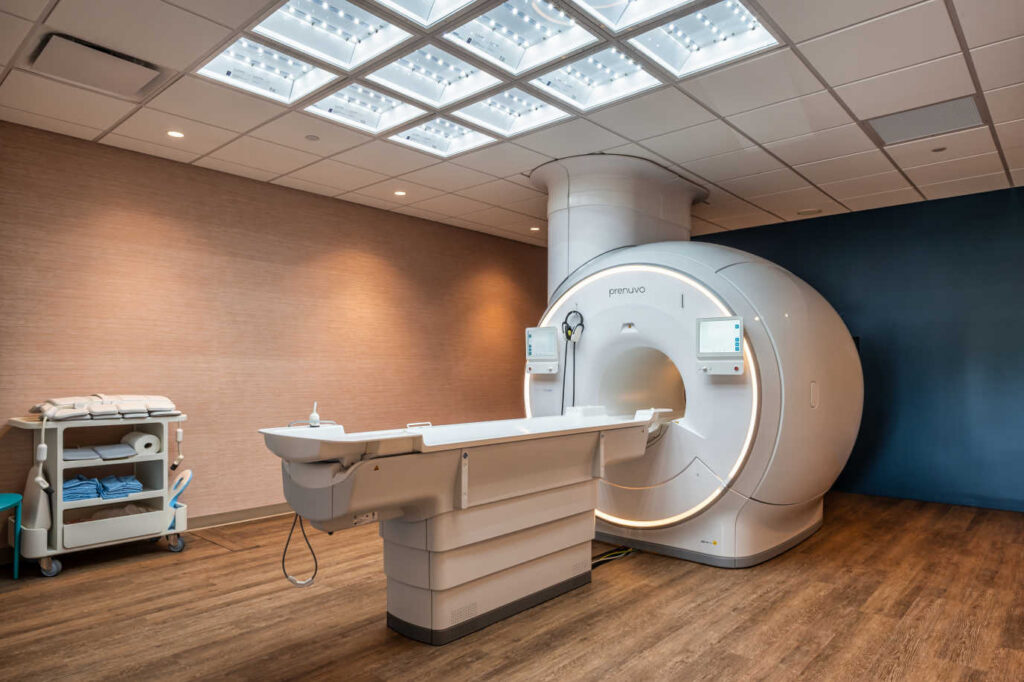
You'll lie on a padded table that moves through the MRI machine. The process is entirely painless, and to help you stay comfortable, headphones and in-scanner entertainment are available throughout.
4
Duration
Most scans take under an hour, and no sedation or downtime is required afterward.
5
Results Review
Your images are reviewed by a board-certified radiologist, and your provider walks you through your findings, what they mean, and any recommended next steps in a dedicated follow-up consultation.
Benefits and Limitations
Whole-body MRI complements, not replaces, standard medical care — it doesn’t substitute for a physician’s evaluation, routine screenings like mammograms or colonoscopies, or diagnostic workups when symptoms are present.
Incidental findings are also common: a scan may flag something that turns out to be benign. Real-world data shows the vast majority of findings need no further action, and less than 1% require urgent follow-up. Your provider will guide you through any results, without unnecessary alarm.
Designed For The Proactive Patient
Whole-body MRI is built for individuals who want to move beyond standard annual screening and take a precision-based approach to understanding their health — earlier, and with greater clarity. It’s a strong fit if you want to:
- Identify risk factors earlier, before symptoms emerge
- Take a proactive approach to longevity and health optimization
- Move beyond the limits of standard annual screening
- Understand your health with greater precision and detail
Biomarker testing pairs naturally with a full-body scan for a complete structural and blood-based picture of your health, and often informs whether hormone replacement therapy is right for you.
Who Should Consider This Scan
As with any imaging tool, whole-body MRI isn’t appropriate for everyone; patients with certain implanted medical devices or severe claustrophobia should discuss alternatives with our team. Currently, we screen patients 18 years of age or older.
Many patients pursue whole-body MRI for reasons unique to their own health journey — a family history of cancer or cardiovascular disease, a desire for a documented baseline before starting a new wellness or fitness program, or simply the peace of mind that comes with a comprehensive look at their internal health. During your consultation, our team will discuss your specific goals and health history to help determine whether whole-body MRI is the right fit for you.
Frequently Asked Questions
Where can I get a whole-body MRI in Denver?
Longevity Medical Denver offers whole-body MRI (also known as a full-body MRI or full-body scan) through our partnership with Prenuvo, right here in Denver, Colorado.
Does a whole-body MRI scan use radiation?
Whole-body MRI uses magnetic fields and radio waves, not ionizing radiation, and does not require injected contrast agents.
How long does a whole-body MRI scan take?
Most scans take under an hour, depending on the regions being assessed.
Is a whole-body MRI scan painful?
No. The scan is painless. Some patients experience mild discomfort from lying still for an extended period, which our team helps manage throughout your visit.
Can a whole-body MRI scan replace my regular screenings?
No. It’s designed to complement standard care, not replace physician-ordered diagnostic testing or age-appropriate screenings like mammograms or colonoscopies.
Will insurance cover a whole-body MRI scan?
Because whole-body MRI is generally used for proactive screening rather than to investigate a diagnosed symptom, it’s often not covered by insurance. Our team can walk you through pricing and any available options during your consultation.
Is there an age requirement?
Yes — we currently screen patients 18 years of age or older.
Do I need to do anything to prepare for my scan?
Yes — please avoid eating for 4 hours before your appointment, and drink only clear liquids during that time. Beyond that, you’ll simply remove metal objects, jewelry, and electronic devices before your scan; no medication changes or additional advance prep are needed for most patients.
Ready to get started?
This page was medically reviewed by Scott Ross, MD in September 2026. Content is reviewed regularly to reflect current clinical guidance.